How to Fix a Hole in Drywall From a Door Knob
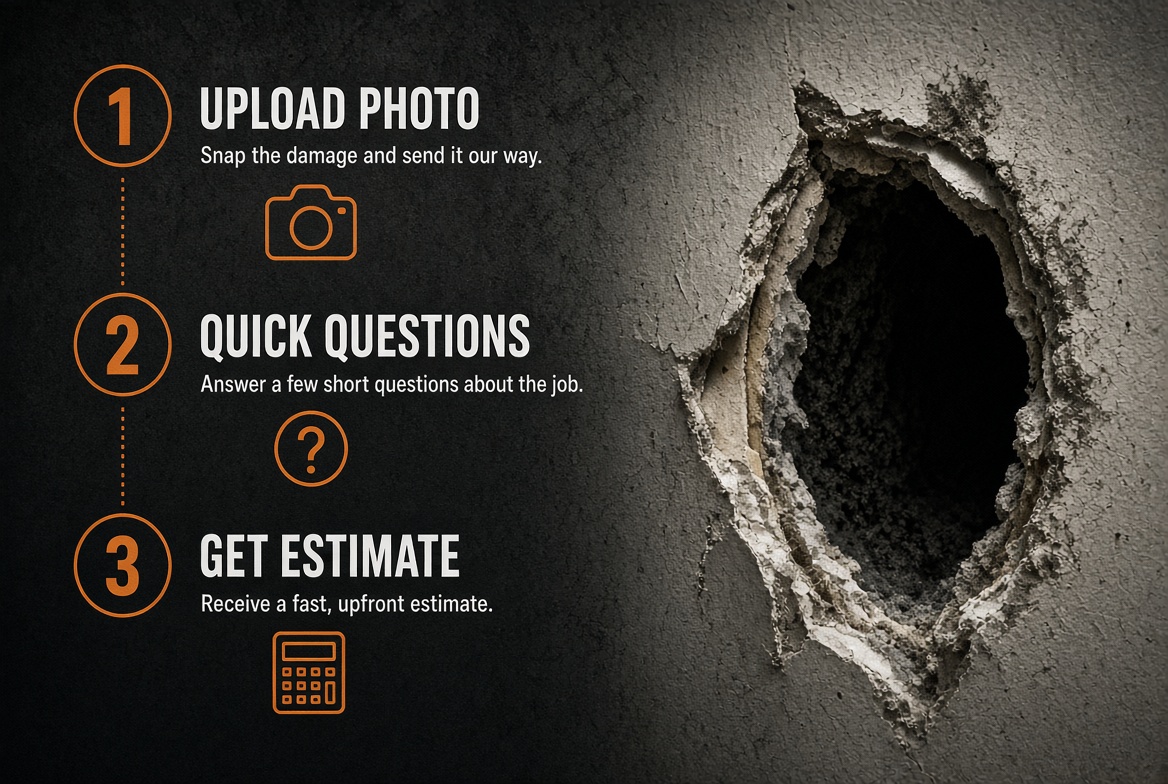
A door swings too hard, the knob hits the wall, and now there's a round hole about the size of the knob. Good news: this is one of the most common drywall holes, and it's very fixable. Measure it, cut the edges clean, put a patch over it, apply thin coats of compound, sand, prime, and paint. Then add a door stop so the knob can't hit the same spot again.
Doorknob hole repair: quick answer
- Most doorknob holes are 2–3 inches across. That's too big for spackle alone and just right for a patch.
- Use a California patch or a mesh patch. Either one gives the compound something solid to sit on.
- Plan on a few thin coats. Each one has to dry before the next, so DIY usually runs into a second day.
- Finish with a door stop. If you skip it, you'll probably be patching the same spot again.
Size it up first
Before you buy anything, measure the hole. Measure the widest point, including any torn paper or soft, crushed gypsum around the edge. The damage is often bigger than it looks from across the room.
| Hole size | What it usually looks like | Best fix |
|---|---|---|
| Under ~1" | Knob just broke the surface | Lightweight spackle, two thin coats |
| ~1–2" | Small punch-through, edges mostly intact | Self-adhesive mesh patch + compound |
| ~2–4" (most doorknob holes) | Round hole, torn paper, crushed edges | California patch or metal-reinforced patch |
| ~4–6" | Bigger blowout, edges crumbling | California patch or a cut-in piece with backing |
| Over ~6" | Large section broken out | Cut-in patch screwed to wood backers, or call a pro |
If your hole is 6 inches or bigger, our guide to fixing a fist-sized punch hole covers the backer-board method step by step.
Check behind the wall before you cut
Light switches are often mounted right beside a door, on the latch side. That means wires can run close to a doorknob hole. Shine a flashlight into the hole and look around before you cut anything bigger.
If you see wires, a box, or pipes nearby, cut carefully with a hand saw, not a power tool. Turn off the breaker for that wall if you're unsure. The Electrical Safety Foundation International has good basic guidance on working safely around home wiring.
Tools and materials
For a typical doorknob hole, here's what you need:
- Utility knife with a fresh blade
- Drywall jab saw (keyhole saw)
- Tape measure and pencil
- Scrap of 1/2" drywall (many stores sell small pieces), or a self-adhesive patch kit
- Lightweight joint compound or premixed all-purpose compound
- 4" and 6" drywall knives
- Fine-grit sanding sponge or 120–150 grit sandpaper
- Primer and matching wall paint
- Drop cloth and a damp rag
- Door stop (see below)
Typical spend: about $25–50 in materials for a medium hole like this, more if you're buying tools from scratch. Our drywall hole repair cost guide breaks down DIY and pro ranges by hole size.
How to fix a doorknob hole in drywall, step by step
This is the California patch method. It's the most reliable DIY fix for a 2–6 inch hole because the patch piece keeps its own paper face, which works like built-in tape.
- Clean up the hole. Cut away loose paper and crumbled gypsum with a utility knife. You want firm edges all the way around.
- Square it up. Draw a square or rectangle around the hole, about half an inch past the damage. Cut along the lines with the jab saw. A clean square is much easier to patch than a ragged circle.
- Cut the patch piece. Measure your opening. Cut a piece of drywall 2 inches bigger than the opening on every side. So a 3" x 3" hole gets a 7" x 7" piece.
- Make the "plug." On the back of the patch piece, mark the size of your opening in the center. Score along those lines, snap the gypsum, and peel it away from the front paper. Leave the paper intact. You end up with a plug the size of the hole and a 2-inch paper flange all around it.
- Test the fit. The plug should slide into the hole snugly. Trim it if it's tight.
- Set the patch. Butter the edges of the hole and the back of the paper flange with a thin layer of compound. Press the plug in and smooth the paper flat with your 4" knife, working from the center out. Squeeze out air bubbles and extra mud.
- Let it dry. Premixed compound usually needs several hours to overnight, depending on humidity and how thick it went on.
- Second coat. Use the 6" knife to apply a thin coat over the whole patch, feathering it a couple of inches past the paper edges. Thin is the goal. Thick coats cause humps.
- Third coat if needed. Once it's dry, lightly knock down any ridges and apply one more thin, wide coat. This is the one that makes the patch disappear.
- Sand lightly. Use a fine sanding sponge with a light touch. Stop when the edges blend into the wall and you can't feel a ridge with your fingertips.
- Prime, then paint. Fresh compound soaks up paint differently than the rest of the wall. Spot-prime the patch first, then paint. If the wall is older, painting corner to corner on that wall often blends better than a small touch-up.
Faster option: a self-adhesive patch
For a clean hole around 2–4 inches, a peel-and-stick patch works too. Pick a metal-reinforced one for doorknob holes, since that spot takes hits. Stick it over the hole, then skim it with compound. Use two or three thin coats, feathered wide, so the edge of the patch doesn't show through the paint.
Stop it from happening again: add a door stop
This is the step most people skip. Without it, the knob will find the same spot again. Common options:
- Hinge-pin door stop. It mounts on the door hinge pin and keeps the door from swinging too far. There's nothing to screw into the wall or floor.
- Baseboard door stop. Either a spring or a solid stop. It screws into the baseboard where the bottom of the door hits.
- Wall-mounted knob bumper. It's a small rubber or plastic disc that sticks to the wall exactly where the knob lands. It's cheap and quick, and it covers the spot if the patch isn't perfect.
- Floor-mounted stop. It's useful where there's no baseboard in the right spot.
Hinge-pin and baseboard stops keep the knob from ever reaching the wall. That's the better fix if kids or wind slam the door.
How long a DIY doorknob patch takes
| Step | Hands-on time | Waiting time |
|---|---|---|
| Cut, fit, and set the patch | 30–45 minutes | Dry several hours to overnight |
| Second and third coats | 15–20 minutes each | Dry time between each coat |
| Sand, prime, paint | 30–45 minutes | Paint dry time |
Most DIY doorknob repairs end up stretching over two days or a weekend. The work itself is short. The drying is what takes time.
When to call a pro
DIY is great for a clean hole in a hallway or closet. Consider a pro when:
- The hole is bigger than about 6 inches, or the edges keep crumbling as you trim them.
- You see wires, a switch box, or pipes right at the hole.
- The wall is in a main room, and a visible patch would bug you every day.
- You've already tried to patch it, and it shows through the paint.
- You need it done before a showing, a move-out, or guests arriving.
WhatAHole techs dry each coat of compound with a heat gun, so about 90% of hole repairs are finished in one visit. Not sure which way to go? Snap a photo of the hole at WhatAHole to get a real price, then decide. Our photo estimate tips show how to take a shot that's easy to price.
FAQ
Can I just fill a doorknob hole with spackle?
Only if it's under about an inch and the edges are solid. Bigger holes need a patch behind or over them. Spackle alone will sink, shrink, or fall in.
What's the best patch for a doorknob hole?
A California patch is the most reliable for a 2–6 inch hole. A metal-reinforced self-adhesive patch is faster and works well for clean, round holes.
Do I need to find a stud to fix a doorknob hole?
No. A California patch or self-adhesive patch holds on the surrounding drywall. Wood backers are only needed for bigger holes, usually 6 inches and up.
How do I keep the doorknob from making a new hole?
Install a door stop. A hinge-pin or baseboard stop keeps the knob off the wall entirely. A wall bumper cushions the hit right where the knob lands.
How much does it cost to fix a doorknob hole?
DIY materials typically run about $25–50. For a price on your actual wall, upload a photo at WhatAHole and get a real number before you decide.