Patch or Replace? When a Drywall Hole Needs a New Section
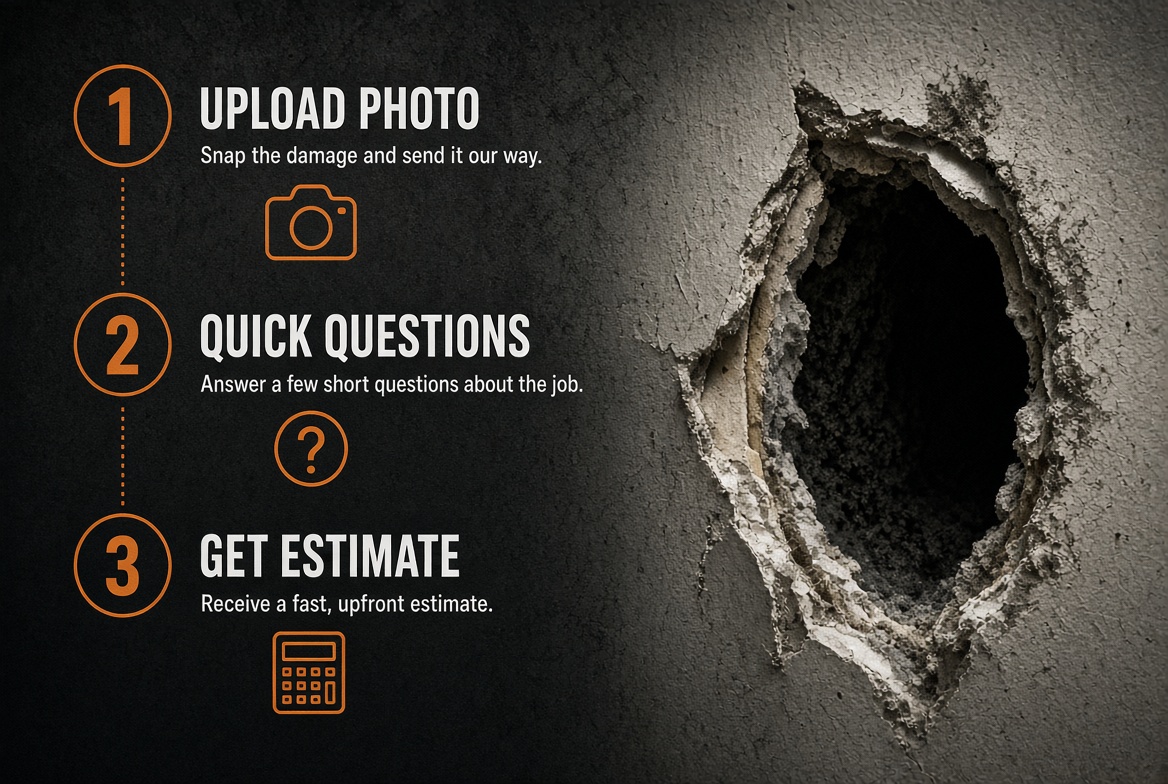
A hole in drywall almost never means replacing the whole sheet. Small and medium holes get a patch that bonds or screws to the drywall around them. Bigger holes get a new section of drywall cut to fit, either backed with wood strips or cut back to the studs. A full sheet only makes sense when the damaged area covers a big share of the panel or several big holes sit close together.
Quick answer: patch or replace?
- Small holes (about 2 inches and under): patch. Fine Homebuilding says a self-adhesive patch or crisscrossed mesh tape handles holes under about 2 inches (Fine Homebuilding).
- Medium to large holes (up to about 13 inches): patch with backing. Drywall 101 says backed patch methods work for holes up to 13 inches, as long as the drywall around the hole is solid (Drywall 101).
- Holes larger than about 13 inches: replace a section. Cut the drywall back to the nearest studs and screw in a new piece (Drywall 101).
- A full sheet: only when the damage spreads across a big part of the panel. One remodeling company puts the line at roughly a third of a panel, or several damaged spots close together (HouseWorks).
- Either way, it's usually one visit for a pro. A WhatAHole tech dries each coat with a heat gun and finishes about 90% of hole repairs in one visit.
Patch vs. new section vs. new sheet: what each one means
People use "replace" loosely, so it helps to separate three different repairs.
- Patch: something bridges the hole and gets buried in joint compound. That can be a mesh or metal patch, a California (butterfly) patch, or a drywall plug screwed to backing strips. The wall around the hole holds it.
- New section: you cut out the damaged area as a clean rectangle and screw in a new piece of drywall. For bigger openings, the edges land on studs, so the framing holds the new piece instead of the old drywall.
- New sheet: you remove a whole panel and hang a new one, then tape and finish every seam around it.
For holes, the real decision is usually between the first two. Even a large hole from a fall or moving furniture tends to stay within one stud bay, and a section between two studs fixes it without touching the rest of the wall.
Where the size lines fall
Sources draw the lines in slightly different places, but they line up well.
- Under about 2 inches: compound plus a small self-adhesive patch or mesh tape (Fine Homebuilding).
- Up to about 6 inches: a California patch works without backing. Our no-stud guide covers the steps. Drywall 101 suggests switching to a backed patch once a hole gets past about 8 by 8 inches.
- Up to about 13 inches: a strapped backing patch, where a short piece of wood or metal stud goes behind the hole, gets screwed to the existing drywall, and holds the new plug (Drywall 101). Fine Homebuilding gives similar advice: anything larger than your hand should be trimmed back to solid drywall, furred out, and patched.
- Larger than about 13 inches: Drywall 101 says the repair needs backing attached to the framing, not to the surrounding drywall, so cut back to the nearest stud. Fine Homebuilding says that for really large holes, furring strips stop being effective, and you cut back to the framing and add cross framing.
Not sure which size group you're in? Measure the hole after you trim off crumbled gypsum and torn paper, not before. Our guide on how big of a hole you can spackle breaks down the smaller end of the range.
Signs a hole needs a new section instead of a patch
Size is the main test, but a few other things push a repair toward a new section.
- The edges won't hold a screw. Backing strips depend on solid drywall around the hole. If the edges crumble when you press on them, keep trimming until you reach firm board. If that makes the opening very large, cut back to the studs.
- The hole reaches a stud anyway. If one side of the opening already sits on a stud, cutting back to the center of that stud is often easier than fighting a strip next to it.
- Two or more holes are close together. Separate patches that nearly touch can be harder to hide than one clean section.
- A previous patch failed. If an old patch is cracked, loose, or bulging, cutting it out and putting in a clean piece usually gives a better result than patching over it. See why a drywall patch looks bad.
How a section replacement works
A section repair is still a hole repair. It just uses the framing for support.
- Check behind the wall. Look for wiring and pipes before you cut. Turn off power at the breaker if you're near an outlet or switch.
- Find the studs. Wall studs are usually 16 inches apart, measured center to center, and some newer homes use 24 inches (This Old House).
- Mark a rectangle that ends at the center of a stud on each side. That leaves about 3/4 inch of stud for the old drywall and 3/4 inch for the new piece (Home Project Resources).
- Cut it out. USG's instructions say to cut along the studs with a utility knife and between the studs with a keyhole saw (USG).
- Add blocking if the opening is tall. Short horizontal pieces of wood at the top and bottom give all four edges something to screw into (Home Project Resources).
- Screw in a new piece of the same thickness. USG's repair clips are made for both 1/2 inch and 5/8 inch drywall, and the new piece must match the wall or it won't sit flush.
- Tape and finish. USG says to tape all four sides without overlapping the tape, then apply second and third coats of joint compound, letting each coat harden before the next.
The finishing is where a section repair takes skill. The cut edges of a section have no factory taper, so the joints have to be built up slightly and feathered wide. Home Project Resources says a well finished joint like this is often 16 to 24 inches wide. Our large hole guide walks through the full process.
Why a full sheet is rarely the answer for a hole
- More seams to finish. A full sheet means taping and finishing every edge of the panel, plus any corners it touches, instead of four short seams around one section.
- The result isn't better for a single hole. When the drywall around the hole is solid, a section between studs is just as strong, because it's screwed to the same framing.
A full sheet starts to make sense when the holes and damage together cover a large share of the panel. At that point, finishing many patches can take longer than hanging new board.
Patch or section: when to call a pro
Choosing between a patch and a section is easy once you measure. Doing the section well is harder. It may be worth handing off when:
- The hole is near wiring, an outlet, or plumbing.
- The opening is big enough that it needs to be cut back to the studs.
- You don't have scrap drywall in the right thickness, a saw, or finishing knives.
- You're on a deadline, like a move-out walkthrough or a showing, and can't wait for each coat to dry.
WhatAHole repairs drywall holes only, from small punctures to large holes cut back to the studs. Techs dry each coat with a heat gun, so about 90% of hole repairs are finished in one visit. Send a photo of your hole for a quote.
FAQ
Can you patch a large hole in drywall, or do you have to replace it?
You can patch most of them. Drywall 101 says backed patch methods work for holes up to 13 inches when the surrounding drywall is solid. Larger openings get a new section cut back to the studs, which is still a localized repair, not a new sheet.
When should you replace drywall instead of patching it?
For a hole, replace a section when it's larger than about 13 inches, when the edges are too weak to hold backing, or when several holes sit close together. Replace a full sheet only when damage covers a big part of the panel. HouseWorks puts that at roughly a third of a panel.
Do you have to cut drywall back to the studs to fix a hole?
Not for most holes. Small and medium holes can be patched with a mesh patch, a California patch, or wood backing strips, with no stud needed. Cutting back to the studs is for large openings, roughly over 13 inches per Drywall 101.
Where do you cut drywall when replacing a section?
Cut so each vertical edge lands on the center of a stud. That gives both the old and the new drywall about 3/4 inch of stud to screw into. Check for wires and pipes before you cut.
Is a patched section as strong as the original wall?
When it's screwed to the studs or to solid backing and taped on all four sides, yes. Fine Homebuilding notes that a patch secured to backing becomes a solid part of the drywall and is unlikely to crack or come loose.
Can a large hole be fixed in one visit?
Usually. DIY section repairs often spread over a couple of days because each coat of compound has to dry. A WhatAHole tech heat dries every coat and finishes about 90% of hole repairs in one visit. Get a quote by sending a photo.